
-

Ryan O’Hanlon
Multiple authors
Before he suffered the injury during Sunday’s warm-up at Nottingham Forest, it looked as if Florian Wirtz had turned a corner. Considering how bad Liverpool looked in the first 85 minutes of that game, his recent rise in statistics may underestimate how important he is to his new team. But it’s not just him.
Since the calendar flipped to 2026, most of the Premier League’s best attacking players have been summer signings. In 2026, Chelsea’s Joao Pedro, Arsenal’s Victor Gjukeris and Manchester United’s Benjamin Sisko tied for the league lead with five goals scored without penalties.
Goals, of course, can be noisy: some great finish, lucky deflection, or goalkeeper error is not made by a great goalscorer. But Cisco is fourth in expected goals, Joao Pedro is third, and is one place above Liverpool’s Hugo Equitiki, another summer signing. Meanwhile, Wirtz ranks eighth in xG, and if we add expected assists to create a rough measure of offensive performance, Wirtz would move into third place – one point behind Ekitike.
Even in north London, where Tottenham are already in charge of their second manager of the season (hello Igor Tudor) and are now trying to beat back a real chance of relegation, Xavi Simons is also starting to improve. He ranks 12th on the expected goals + assists chart since the turn of the new year.
So, with so many summer signings now at their new clubs, and with most of them joining from different leagues, it’s really tempting to dig into that huge bag of English football clichés and declare that, well, “they just needed time to settle in” – to get used to the pace and pressure of the Premier League, to understand that you’re not in the Bundesliga anymore, Hugo.
Instead of doing so, we will question the hypothesis altogether. Let’s take a look at recent history and answer the question: Do players new to the Premier League actually improve once they get used to the league, or is this just hopeful thinking?
-Why is the Champions League so easy for Premier League teams?
– Top 50 USMNT players of 2026 so far, ranked by club form
– Ranking: Top 25 manager jobs, from best to worst
How to know which conversions are getting better
To get an answer, I went back and looked at all the major attacking signings that Premier League clubs have made for players outside of England in the summer transfer window since the 2015-16 season. I set the cap at €15m (per Transfermarkt data), but then personally added a couple of players who also felt as though they fit the spirit of the exercise.
To define “striker,” I used players listed as strikers, wingers, or attacking midfielders. Why only attackers? Why only summer contracts?
I chose attackers because their performance is easier to measure. These players generally play well if they create a lot of shots and chances for their teammates, while midfielders and defenders have more ambiguous and context-dependent responsibilities.
I decided to only look at summer signings because January signings confuse the exercise. I wanted to know if players from outside the Premier League improved as they continued their first season in the Premier League. Players signed in January get less than half the season, after which the ‘second half’ will be the following season, after they have been given a full pre-season to integrate with the new team.
So, to keep things simple, we ended up with 80 players who played at least 300 minutes in both the first and second halves of their first seasons with their new teams. To judge the progress of their performance, we will simply look at what they did during the first 19 games of the season and the last 19 games of the season.
This of course excludes players who may not have reached the minutes limit in the first and second half because their coach thought they were playing too poorly. While this would naturally weed out players who have gotten worse or improved, there are roughly equal numbers of players on both sides of that dilemma, so I moved forward with the 300-minute threshold.
Why is the Premier League’s adjustment period so real?
To measure each player’s performance, I looked at nine different statistics. Here’s how the performance of all 80 players changed from the first half of the season to the second half:
• Objectives: 5.7% increase
• xG: 11.9% increase
• Helps: 0.6% increase
• Shah: 5.9% decrease
• Opportunities created: 1.6% increase
• Screenshots: 4% increase
• Touches inside the penalty area: 6.3% increase
• Passes into the penalty area: 5.1% increase
• Successful dribbles: 3.5% decrease
So, everything becomes a little better: they take more shots, shoot much better, get to the ball inside the box more often, play more passes into the box, and score more goals. All of these seem like clear indicators that a player is playing better – and these are the main ways in which strikers help their teams win games.
But they also double as indicators of players settling into new systems and a new league. They are increasingly finding spaces in the most dangerous areas of the field, and this leads to increased production.
I think this is true even in one of the declining statistics: successful dribbles. If you’re struggling to impose yourself within the confines of your new team’s tactics and formation, one simple way to try and make a difference is to try to beat your man with the ball. Maybe, once you influence play around the penalty area more often, you won’t feel the need to do so anymore. Or you start to influence play around the penalty area more when you stop trying to dribble.
But the strangest part is the low number of expected assists. This is not expected to be passed for goals, which gives an xG value to any shot attempt by the person who passed the ball to the shooter. Instead, xA calculates the probability that each pass, whether it actually results in a shot or not, will turn into a goal.
In theory, it shouldn’t be as loud as xG assist, and should be a better representation of actual passing skill. But it is very difficult to compensate for the almost equal decrease in xA with the improvement of passes into the penalty area. Research has shown that passes into the box are more repeatable than actual assists and xG assists, so I tend to scoff and just say that there is no real change here at all in terms of how new players impact matches with their passes.
1:45
Has Victor Gyukiris finally settled at Arsenal?
Janusz Michalek joined Mark Donaldson to react to Arsenal’s 3-0 win over Sunderland in the Premier League.
Winter and summer contracts
Last summer, there were six players who moved to the Premier League from teams outside England for fees of €60m or more: Wirtz and Ekitiki to Liverpool, Sisko to Manchester United, Jokeres to Arsenal, Simons to Tottenham, and Nick Woltmad to Newcastle.
On the whole, they’ve all improved since the start of the season – across every metric per 90 mentioned previously:
• Objectives: 52% increase
• xG: 19.2% increase
• Helps: 12.1% increase
• Shah: 66% increase
• Opportunities created: 6.5% increase
• Screenshots: 27.2% increase
• Touches inside the penalty area: 18.8%
• Passes into the penalty area: 28%
• Successful dribbles: 1.8%
Now, the second-half numbers we’re comparing here are a much smaller sample of games – eight or nine, compared to the 19 from the first half – but that should lower our expectations of how much they’ve improved, rather than making us wonder whether they’ve actually improved or not at all.
Wirtz, Eiktike, and Simons are all up significantly in almost every metric — and they’ve all played a lot of minutes so far in the second half. Sesko’s passing numbers have all dropped, but his shooting production has been astronomical at 90 since midway through the season.
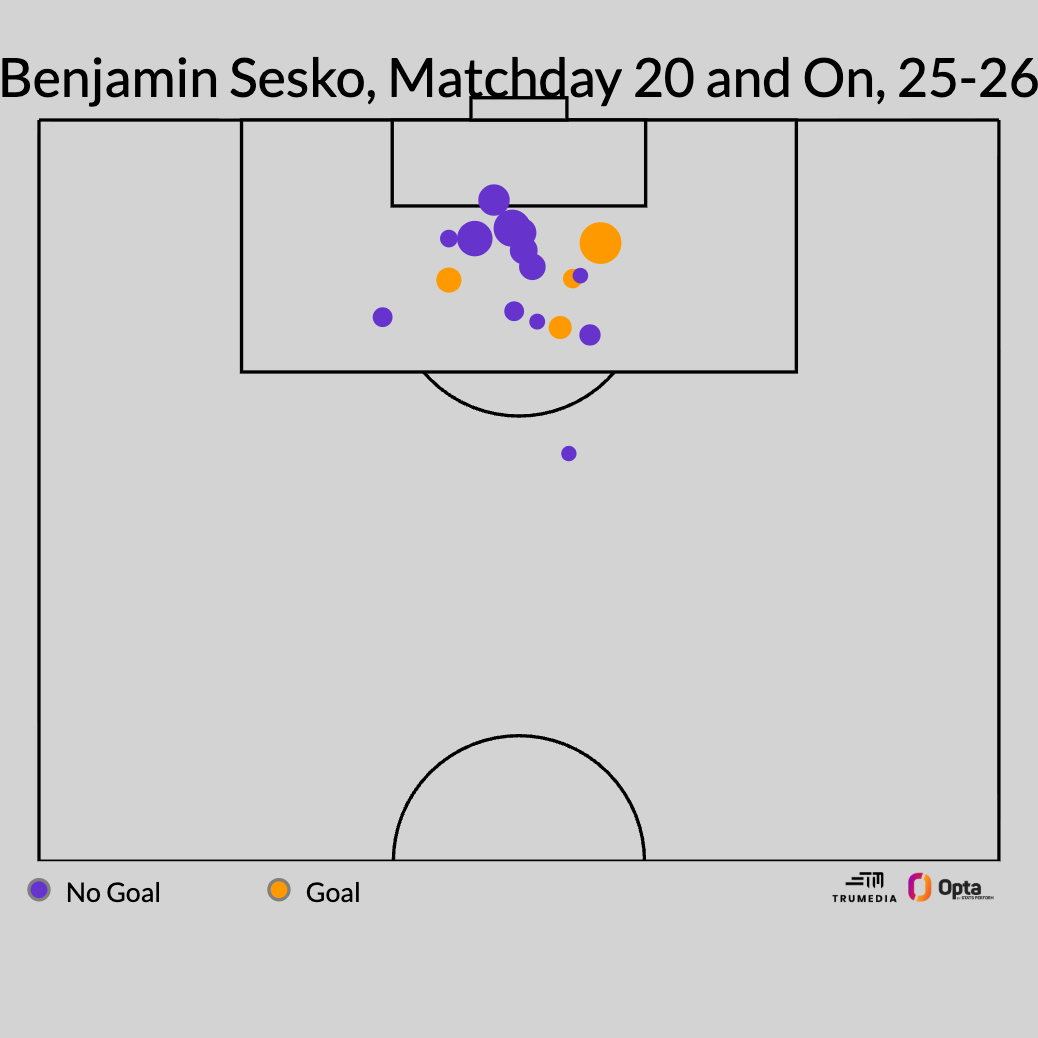
However, he has started just two league matches this year, missing out on playing time under Manchester United interim manager Michael Carrick. But in his past four league games, totaling around 90 minutes, he has scored three goals and attempted seven shots. There’s still a lot to work with – Cisco is still only 22 years old.
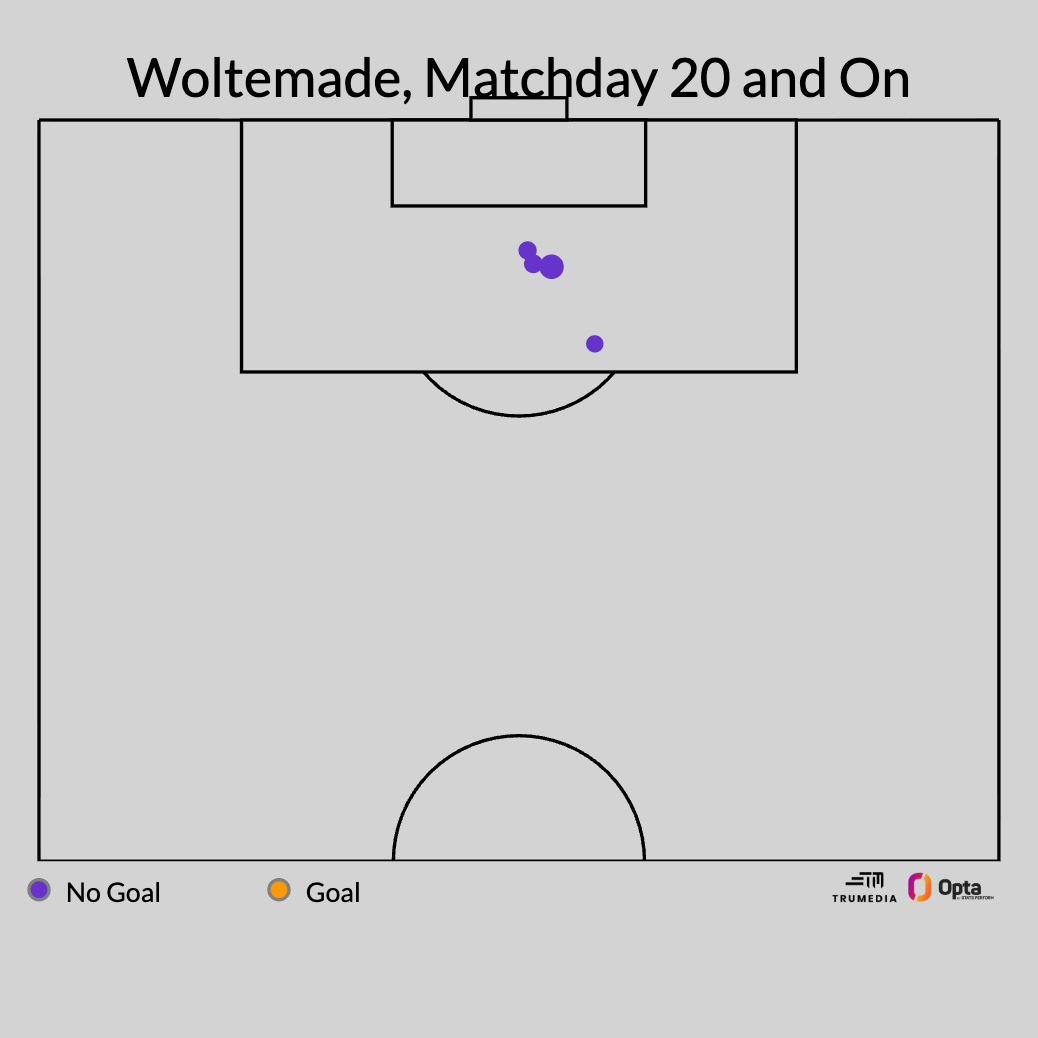
Meanwhile, Woltemade is the only clear violator of the positive trend: his previously meager passing numbers are up, but he has yet to score in the second half, and his xG production is down 76%. These are all the shots he made in the second half of the season:
With Gyokeres, it’s less clear. After making Tottenham’s defenders look like they were playing Boavista on Sunday, he scored twice as many goals per 90 minutes in the second half of the season as in the first, but his xG production fell by 36%, his touches in the opposition penalty area fell at almost the same rate, and his shots per 90 fell by more than 20%.
Maybe Arsenal want him to be on the ball in the box less because it means he makes more runs into space as we saw him do with Sporting Lisbon? It hasn’t really proven itself beyond the game we just saw.
Most players will not be like Erling Haaland or Mohamed Salah and will dominate the league from the day they emerge. As we have seen so far this season – and as we have seen over the past decade – we must be more patient with players joining from different leagues. There really does seem to be a ‘bed-in’, ‘settle-in’ or ‘(insert cliche of choice)-in’ period for strikers who join the Premier League from other countries.
However, based on historical numbers, it is not as if we should expect everyone To improve at the 5% or 6% rates we specified earlier. No, we would have expected slightly more of the Premier League’s new attacking signings to show improvement in the second half of the season than they did not. We expected some to improve more from baseline, and some to decline more.
We have to give these players more time to adapt, yes, but that doesn’t mean it will always pay off.