
-

Ryan O’Hanlon
Multiple authors
Last year seemed like the worst-case scenario.
Everything has gone wrong for Tottenham Hotspur. Everyone was hurt. They were incredibly unlucky in close matches – scoring 64 goals and conceding 65 – and they also eventually stopped caring about the Premier League, instead pushing all their focus towards winning the Europa League, which they did.
Thus Tottenham, the ninth richest football club on Earth, according to Deloitte, finished last season in 17th place in the domestic league. Even so, they were not in danger of relegation. They gained 12 points over 18th-placed Leicester City, and their goal difference was 46 better than the Foxes.
This seems to prove that the “Big Six” clubs in England are too big to fail. This is why these teams are worth billions of dollars, while any other team can be bought for a few hundred million dollars.
Well, it turns out that things can actually always go wrong. With nine games remaining this season, Tottenham are just one point clear of 18th place, the relegation zone. They still have to go to Anfield to face Liverpool and to Stamford Bridge to face Chelsea, and they will host Nottingham Forest, tied for 18th on points, towards the end of this month.
Prediction models, betting markets and sentiment are telling us the same thing: there is a very real chance Tottenham will be relegated and find themselves playing in the Championship next season.
That would be an unimaginable historical disaster, and it has to be the worst Premier League season in the modern era… right? Let’s find out.
– The Premier League is boring right now – here’s how to fix it
– Top 50 USMNT players for 2026, ranked by club form
Do summer transfers in the English Premier League require more patience?
Identifying the ‘worst’ teams in the English Premier League
One of the main problems with the Premier League – both broadly and from an analysis point of view – is that the game is rigged. Not everyone has the same amount of money to spend, so it’s not fair to simply judge Manchester City’s points total directly versus Brentford. No, we need to control for the money each team spends, and then compare it to some sort of expected level of performance.
And that’s what we did here. First, I took a look at Transfermarkt’s estimated market value for every Premier League roster since the 2010-11 season. These numbers tend to correlate very closely with the amount of money each team spends on its players. Next, I looked at each season individually and calculated the expected points total based on the relationship between points won and the team’s market value in each given season.
So, to come up with these rankings, I simply compared each team’s actual point totals to their expected point totals. The following are the 10 teams that finished furthest from their projected projections.
10. Manchester United, 2024-25
• Expected points per match: 1.57
• Actual points per match: 1.1
In Sir Alex Ferguson’s final three years with the club, Manchester United beat their expected points total by an average of 0.23 points per game – or almost nine points per season. Since then, they have underperformed by about 0.09 points per game, or about 3.5 points per season.
That number doesn’t seem as low as it could be, but just think of all the ‘Manchester United are back’ articles you’ve read over the past decade. Football is a random sport, and United always have talented rosters, so they still have some high seasons amid the overall decline. The question for the future then is: Are we seeing more of the same?
Last season was United’s worst in the data set, while this season so far will be United’s best. Now, this is largely because their roster is estimated to be the sixth most valuable in the league currently, but we’ve seen this story before.
Is the club headed towards some long-term success, or is this just another high point amid a longer story of eventual decline?
9. Southampton, 2022-23
• Expected points per match: 1.21
• Actual points per match: 0.7
Stats Performance has shooting stop data dating back to the 2018-19 season. By “shot stopping” data, I mean they look at where each shot ended up in the frame of the goal, calculate the probability of each shot being scored, and then compare the combined goal probability of all the shots the goalkeeper faced to the number of goals the goalkeeper actually conceded.
These numbers are incredibly noisy from season to season, but goalkeeper Gavin Bazunu’s 2022-23 season with Southampton was the worst in the data set:
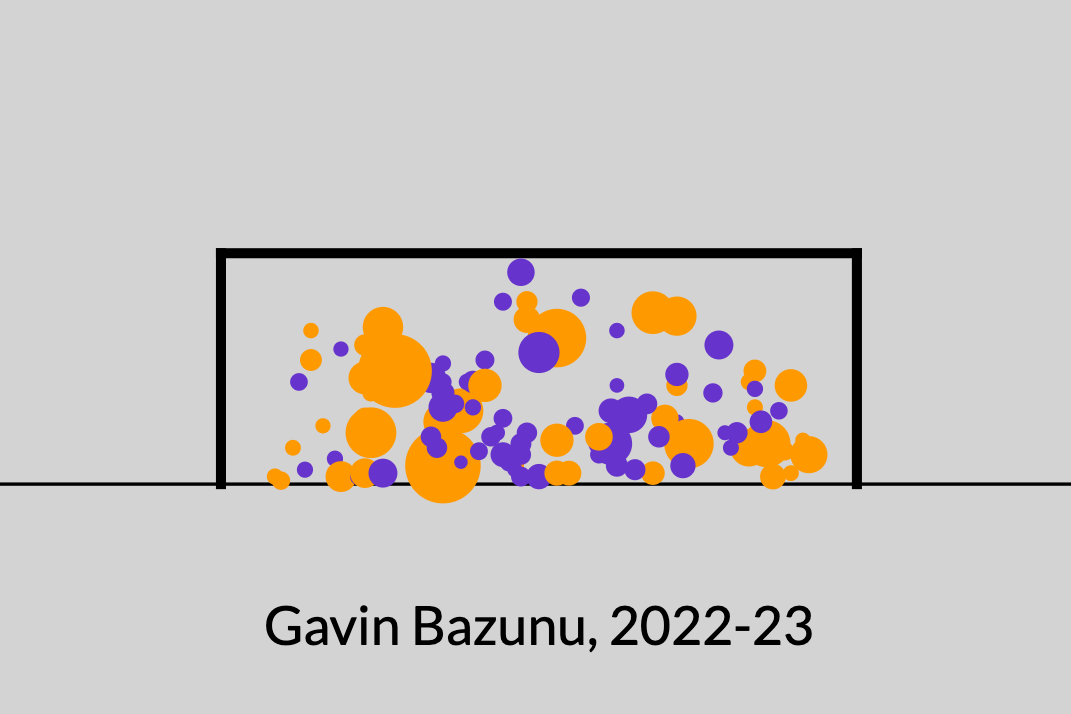
Orange points are goals, purple points are shots, and larger points mean higher xG, or expected goals, per attempt. It was expected to concede 35.42 goals. He admitted 52.
8. Huddersfield Town, 2018-19
• Expected points per match: 0.92
• Actual points per match: 0.4
At the time, Huddersfield’s goal difference of 16-minus 54 was the worst in the league since 2010. Those totals have been matched and surpassed several times since, but I can’t imagine we’ve seen the following record matched, or if we’ll see it matched any time soon: Huddersfield’s top non-penalty scorers are Matthias Jorgensen and Karlan Grant, with three each.
7. Chelsea, 2015-16
• Expected points per match: 1.82
• Actual points per match: 1.3
Chelsea have 16 seasons in this database, and they have exceeded their expected points total…once.
Funnily enough, it was the 2014-15 season, when they qualified for the Premier League title under Jose Mourinho and then completely collapsed the following year. Eden Hazard won the Player of the Year award with 11 goals, no penalties and nine assists in the 2014-15 season. He scored four goals and made three assists the following season. Mourinho was sacked in mid-December, and Chelsea finished the season in tenth place.
Once owned by a Russian minority who spent $2 billion of their own money on the team, Chelsea are now owned by a group of billionaires who are doing everything they can under Premier League rules to spend as much money as possible on players. Despite all that, they have only truly competed for the title in just two of the past 16 seasons – and won both times.
6. Tottenham Hotspur, 2024-25
• Expected points per match: 1.52
• Actual points per match: 1.0
It may not seem like it, but Spurs have actually developed a very consistent performance pattern. Or at least they are king I developed a very consistent performance pattern.
Here’s how non-penalty expected goal difference has stacked up in each full season since 2010:
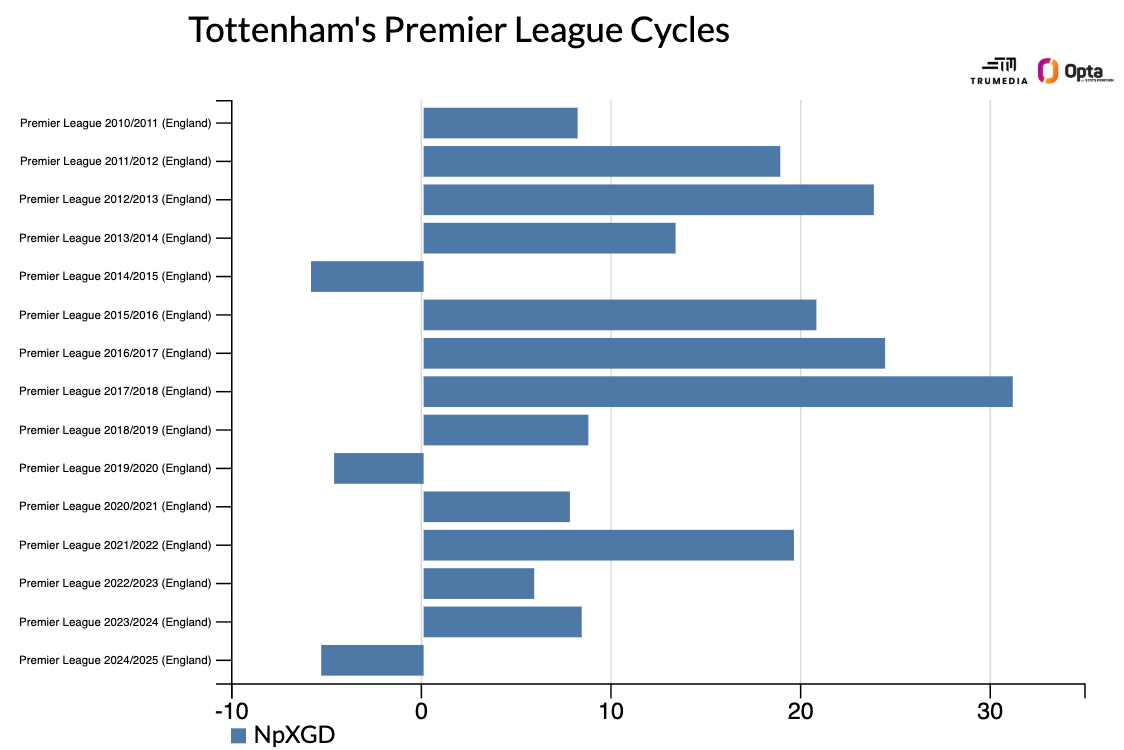
It’s four good years, followed by a down year, followed by four good years, and so on.
Given that Spurs have mostly been a club that sells players in the modern era, this trend makes sense. They acquire a group of good young players, they spend four years together (the average length of a player’s career), and then they leave for bigger, richer clubs or they stay and it gets worse. Then it all happens again.
The worrying parts are that the recent ‘peak’ was very low, during the era when Tottenham finally established themselves as one of the richest teams in the world. What’s even more worrying is that the chart doesn’t include the current season…
5. Wolverhampton Wanderers, 2025-2026
• Expected points per match: 1.07
• Actual points per match: 0.5
The concept of “form” tends to be meaningless and merely tells us what happened in the recent past. A recent rise in scores does not predict a future rise in scores.
However, Wolves have won 13 of their 16 points in the season since the turn of the year. Expected goal difference over this stretch? Slightly worse than before January 1st.
4. Tottenham Hotspur, 2025-26
• Expected points per match: 1.62
• Actual points per match: 1.0
It’s really hard to believe we’re here, but the way I would explain it is through a combination of injuries, a team-building approach that was completely blind to the concept of ‘passing the football’ as a fundamental skill, and the increasing overall competitiveness of the Premier League.
But the most brutal part about all of this is that you can’t blame it on bad luck. If you told me a ‘big six’ club was legitimately in a relegation battle with less than 10 games remaining, I’d assume ball bounce was playing a big part. Teams go through periods of finishing off throughout the season and failing to stop shots all the time, and you would presumably need that to happen for a team with the Spurs’ resources to drop to such a deep position in the standings.
But this does not happen at all. Here’s how the league currently stands by expected goal difference without penalties:
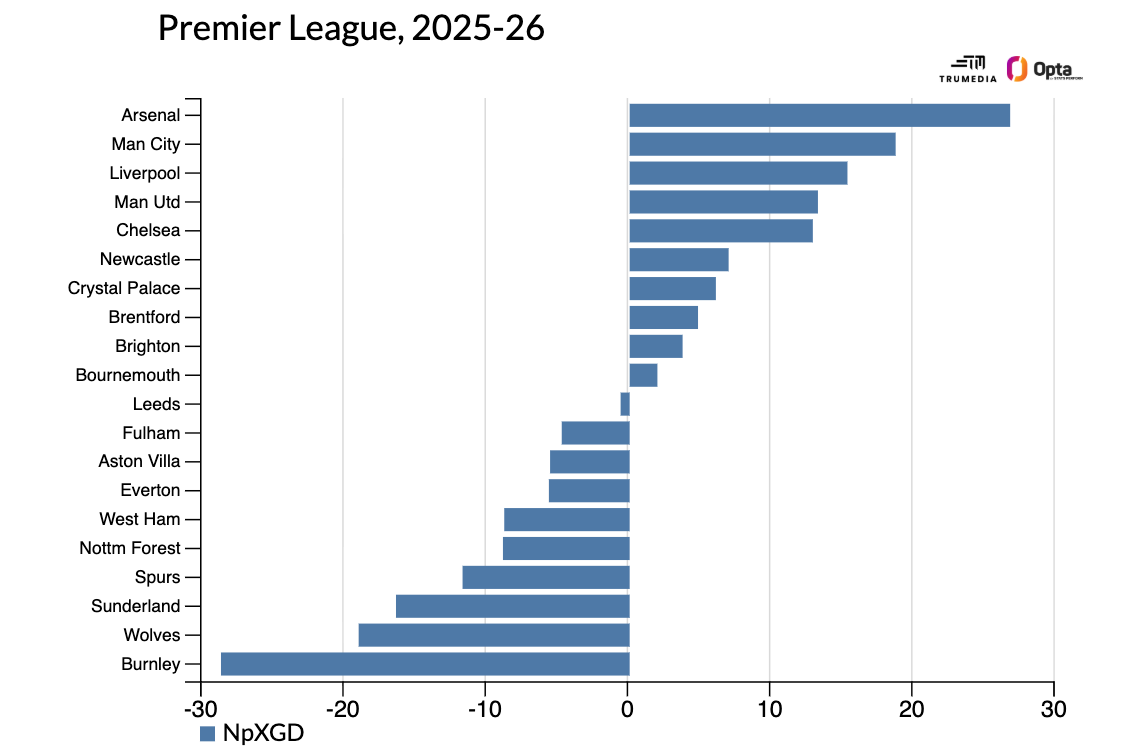
This is correct. With West Ham United and Nottingham Forest ahead of them in this chart, you could make a legitimate argument that Tottenham are ahead. lucky To be in sixteenth place.
3. Southampton, 2024-25
• Expected points per match: 1.05
• Actual points per match: 0.3
Here is the great John Maynard Keynes talking about football tactics:
“Because the essence of his conduct must be eccentric, unorthodox, and reckless in the eyes of ordinary public opinion. If he succeeds, it will only confirm the public belief in his recklessness; if he does not succeed in the short run, which is very likely, he will not have much mercy. Worldly wisdom teaches us that it is better for a reputation to fail conventionally than to succeed unconventionally.”
Well, he’s talking about investing — but he might also be talking about football coaches and why they’re all trying to do the same things. Below is a chart, which I think sums up the pros and cons of the difference. It compares points earned with the percentage of passes completed for each team outside the attacking third:
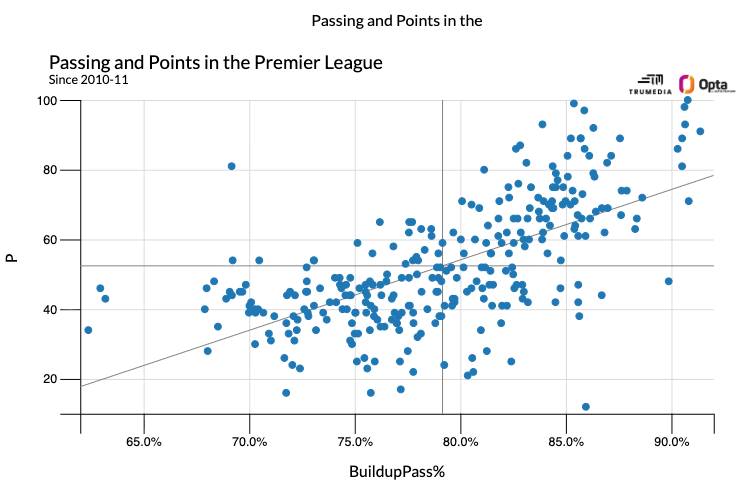
At the top left and bottom right, you’ll see two huge outliers. The team at the top left, which has eschewed patient passing to a degree that few teams have done, is Leicester City, who won the Premier League in 2016. And at the bottom right? It’s Southampton, who tried to dominate the ball like Manchester City and ended up being one of the worst Premier League teams ever.
2. Chelsea, 2022-23
• Expected points per match: 1.95
• Actual points per match: 1.2
Chelsea spent more than €600 million on transfer fees during the first season of Clearlake Capital and Todd Buhle, who own the club. These are the players who were brought in:
• Enzo Fernandes: 121.00 million euros from Benfica
• Wesley Fofana: 80.40 million euros from Leicester City
• Mykhailo Modric: 70.00 million euros from Shakhtar Donetsk
• Mark Cucurella: 65.30 million euros from Brighton
• Raheem Sterling: 56.20 million euros from Manchester City
• Kalidou Koulibaly: 41.90 million euros from Napoli
• Benoit Badiashelli: 38.00 million euros from Monaco
• Noni Madueke: 35.00 million euros from PSV Eindhoven
• Malo wants: 30.00 million euros from Lyon
• Carne Chukwuemeka: 18.00 million euros from Aston Villa
• Cesare Casadei: 14.86 million euros from Inter
• Andre Santos: 12.50 million euros from Vasco da Gama
• Pierre-Emerick Aubameyang: 12.00 million euros from Barcelona
• David Datro Fofana: 12.00 million euros from Molde
• Joao Felix: 11.00 million euros on loan from Atletico Madrid
• Gaga Slonina: 9.09 million euros from Chicago Fire
• Denis Zakaria: €3.00 million on loan from Juventus
Not only did they have no immediate success, sacking two managers en route to a 44-point 12th-place finish, but there was very little long-term success either.
Most of these players are no longer with the club, and only two of them, Enzo Fernandes and Mark Cucurella, have started 20 matches this season.
1. Aston Villa, 2015-16
• Expected points per match: 1.15
• Actual points per match: 0.4
“Tim Sherwood is at his best when he’s backed into a corner.”
-Tim Sherwood
Tim Sherwood said this after managing Villa to a 1-0 loss to West Bromwich. After backing the corner with four points from their first six matches, Villa proceeded to lose their next five matches and Sherwood was sent off. They won just two of their next 27 matches and went down with what was then the third lowest points total in league history.
Villa were one of only seven clubs not to be relegated since the creation of the Premier League. Now, there are six: Manchester City, Manchester United, Liverpool, Everton, Arsenal, Chelsea, and Tottenham.