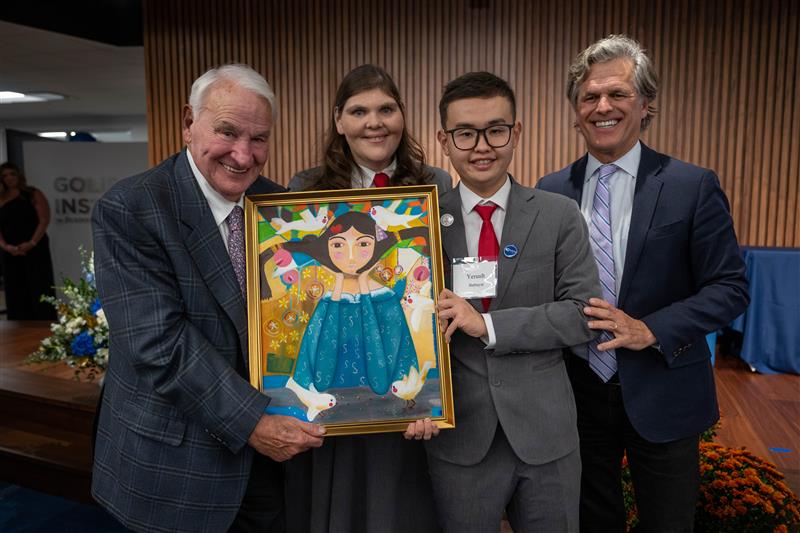

Brandon Fitzgerald, Chief Legal Officer and Board Secretary of Special Olympics, has been a lifelong advocate for justice and equality.
In Brandon’s role, he has been instrumental in ensuring that Special Olympics operates to the highest standards to ensure policies, partnerships and organizational decisions remain firmly rooted in inclusive practices. His work is essential to building a more equitable global sports community that empowers and elevates the voices of Special Olympics athletes around the world.
How long have you been a part of Special Olympics and how did you join the movement?
I joined Special Olympics in January 2022. However, I have been part of or aware of this movement for much longer. I co-created a legal internship program, and we have placed law students in the Special Olympics Legal Department for many years. One year, Angela Ciccolo (former Special Olympics Chief Legal Officer) invited all of the trainees and other individuals involved in the training program to attend a Special Olympics Unified Sports® Bocce event approximately 15 years ago.
Why should everyone celebrate black history?
In college, I was at a speech given by the legendary Dr. Maya Angelou. “I am a human being, and I do not consider anything human alien to me,” she said, quoting the Roman playwright Terence.
When asked why everyone should celebrate Black History, my answer, as a history major, is that Black History is History. It is not separate and distant from the human story.
Black history in America is an essential part of the American story. The architects of the American republic were constantly grappling with race-based slavery. Ultimately, a civil war broke out to determine whether an agricultural economy based on slave labor was America’s future. America was, unfortunately, still grappling with race a hundred years into the Civil Rights Movement.
If you look at the stories of Harriet Tubman, Frederick Douglass, W.E.B. Du Bois, James Weldon Johnson, John Hope Franken, and many others, you will understand American history more deeply.
What black historical figure inspires you and why?
There’s a lot to name. Two of my favorites are Althea Gibson and Arthur Ashe. Gibson, long before Ashe, broke the color barrier in tennis. Not only did these two win multiple Grand Slam titles, but they also fought for civil rights. They had the intelligence and calm presence needed to promote equality.

From your perspective, how do you think institutions and individuals can effectively promote racial equality beyond performative gestures?
The Civil Rights Movement, at its core, was about justice. In an important civil rights case, a restaurant open to the public argued that segregation was acceptable on the basis of religious belief. The US Supreme Court rejected this argument. It is important to take a moment to think about what America would be like if, at any time, someone could exclude individuals from public spaces and justify bias by claiming it is based on a religious belief.
If you are truly committed to fairness, you should work to make the world more fair and just.
Brandon Fitzgerald, Legal Director and Board Secretary of Special Olympics
In the Montgomery Bus Boycott, black taxpayers demanded that public buses treat them like their non-black brothers.

In my opinion, racial equality is about ensuring that Black Americans have the same opportunities and opportunities as other Americans.
If you are truly committed to fairness, you should work to make the world more fair and just. Black Americans are often the tip of the spear when it comes to conversations about equality and justice in America. When you see something that is not working for Black Americans, you can be sure that it is not working for other segments of the population. America is at its best when it works for everyone.
Special Olympics’ work is based on equality. The goal is to help people see the full beauty and ability of individuals with intellectual disabilities (ID). Special Olympics wants to ensure that individuals with disabilities have access to health care and are able to live their fullest lives possible.
As it has been said (in one form or another by various individuals), “the arc of the moral universe may bend toward justice, but it does not bend of its own accord.”
So, if you are serious about actively promoting racial equality, be concerned with the equality of all people. Be committed to the principle that we are stronger together and that an injustice against any of us is an injustice against all of us. If we take care of all of us, regardless of whether we are in the Rust Belt or Black Belt, America wins.
About Black History Month
Since 1976, Black History Month has been observed every February in the United States to honor the achievements and contributions that Black Americans have made to this country.
Since its inception in 1968, African-American athletes and staff have been at the forefront of the Special Olympics movement, leading the way for the inclusion of people with and without ID.
The message of inclusion extends to all people, regardless of race or ethnicity. Visit our website Black History Month A page to learn more impactful stories.