WASHINGTON — After appealing for the highest level of aid to college athletics, President Donald Trump said Friday he will write an executive order within a week that will “address all the issues” addressing the future of college sports in an unprecedented meeting at the White House.
Trump, who was joined by about 50 people of various backgrounds in the East Room, hosted the first “Saving College Sports” roundtable with Vice Chair Secretary of State Marco Rubio, New York Yankees President Randy Levine and Florida Gov. Ron DeSantis.
The group included other politicians, sports celebrities, media executives, conference commissioners, and university presidents, chancellors, and athletic directors. Those who spoke delivered a similar message: College sports need federal legislation to restore order to the NIL space and its overall economy.
“I will get an executive order in a week, and it will be very comprehensive,” Trump said. “And we’re going to take it forward, and we’re going to sue, and we’re going to see how it plays out, OK, but I’m going to have an executive order, which will fix every problem in this room, every conceivable problem, within a week, and we’re going to take it forward. We’re going to sue. That’s the only thing I know for sure.”
NCAA President Charlie Baker was in attendance along with ACC Commissioner Jim Phillips, SEC Commissioner Greg Sankey, Big 12 Commissioner Brett Yormark, Big Ten Commissioner Tony Pettiti, American Conference Commissioner Tim Pernetti and Notre Dame Athletic Director Pete Bevacqua.
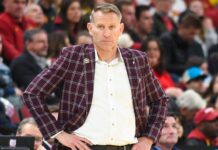
The meeting was scheduled for one hour but lasted about two, and journalists present were allowed to stand in the back of the room for the duration. Former Alabama coach Nick Saban, sitting two seats to the left of the president, spoke first in favor of the college site.
Saban said his goal was to prepare players for success in life and create an environment that would help them through personal development and academic support — and that became “impossible to do in this system.”
“I think we need to come up with a measure, and we need to work with the leadership of the president and Congress, perhaps, whether it’s antitrust legislation or whatever, to allow student-athletes in all sports, including women’s and Olympic sports, to increase their quality of life when they go to college,” Saban said, “but still give them opportunities to take care of themselves that gives them the opportunity to improve themselves. How much nobody talks about college athletics and college education, which is Any of the student-athletes can improve the future.”
Former Ohio State coach Urban Meyer said part of the solution is to “get rid of the collective.”
“It’s cheating,” he said. “Donors put money in a pot. It’s distributed to players through coaches and managers. It’s not allowed. It’s not supposed to be done. It’s pay to play.”
Lawmakers and others in the chamber rallied around hopes that the SCORE Act, an effort by leading Republicans in Congress to create a national NIL and college athletics regulatory framework, would pass. Sen. Ted Cruz said 60 Senate votes are needed, including seven Democrats, but he added that zero Democrats are prepared to vote for it.
Texas Tech billionaire booster Cody Campbell, who has been working on the issue for months, warned that as it moves to the Senate, “some dynamics are going to change.”
“Many agendas in this room and outside this room are becoming impossible,” he said. “The reality is nobody’s going to get everything. If we’re going to come to a solution, we’re going to have to find a place where we’re all equally unhappy, just like any other business deal.”
Phillips told the president, “We need your help,” and said none of the players in the room told the commissioners they wanted to be considered employees.
“They’re smart enough to understand what that means,” Phillips said.
Sankyo expressed a sense of urgency.
“If we fail to act we will create more fractures,” he said.
“I’m going to get an executive order in a week, and it’s going to be very comprehensive. And we’re going to put it forward, and we’re going to sue, and we’re going to see how it works, OK, but I’m going to have an executive order that solves every problem in this room, every conceivable problem, in a week, and we’re going to put it forward, and that’s all we’ll know. Sure.”
President Donald Trump
Sarah Hirschland, CEO of the United States Olympic and Paralympic Committee, said the college feeder system “has been the backbone of Team USA for generations.”
At the Paris Games, he said, athletes represented 231 different colleges and 71 conferences, and 90 different schools were represented by medalists. He cautioned against taking these sports for granted at the collegiate level.
“And while the United States has topped the gold medal table in eight of the last 10 Summer Games, I’m here to tell you that the gap is closing,” he said. “Across the world, nations are investing aggressively in sports, creating centralized training systems, expanding funding and prioritizing athlete development in new ways. Increasing global competition comes at a moment when U.S. colleges must increase their investment in football to remain competitive. The economic pressures are unsustainable. …
“We know what happens when those investments diminish or disappear,” he said. “This disrupts Team USA’s future pipeline, but frankly, it threatens the future health of our nation’s sport. We cannot wait for economic pressures to build on this crisis.”
Notably absent were any student-athletes.
“They are very well represented,” Trump said. “You know why? Because people like Nick Saban and Urban Meyer, people I know in the room — and people I probably don’t know — they all care so much about student-athletes that they care about themselves, so I think they’re really here. In that sense, they’re very well represented here.”